


Page 358 - Haematologica Vol. 109 - July 2024
P. 358
CASE REPORT
Defibrotide improves COVID-19-related acute respiratory distress syndrome in myeloma patients after chimeric antigen receptor T-cell treatment without compromising virus-specific and anti-myeloma T-cell responses
The COVID-19 pandemic has caused significant morbid- ity and mortality, especially in patients with pre-existing comorbidities. Although the introduction of vaccines has decreased both the incidence and severity of the infection, protection is suboptimal in immunocompromised patients. We and others have shown previously that in patients with hematologic malignancies who received chimeric antigen receptor T-cell (CAR T) treatment, antibody responses to currently available vaccines are severely impaired while T-cell responses are largely maintained.1-3. Until we have broader coverage vaccines with stronger, durable immu- nogenicity, we will need treatments that can suppress tis- sue-damaging viral-induced inflammation in patients with CAR T-cell-induced immunosuppression and in particular target the endothelial pathobiology of the virus and its related endotheliitis.
Here, we describe the clinical course and correlative studies of two fully SARS-CoV2-vaccinated patients with relapsed refractory myeloma (RRMM) who had severe COVID-19 infec- tion shortly after their CAR T treatments. Both remained in the intensive care unit (ICU) for prolonged periods requiring
high-flow oxygen despite multipronged therapy. However, their clinical conditions improved remarkably shortly after initiation of defibrotide which was given after obtaining informed consent per institutional guidelines and which appropriately suppressed the harmful SARS-CoV-2-induced non-specific inflammatory response and related cytokine release syndrome (CRS). Importantly, our correlative stud- ies suggested no negative impact either on the mounting of adaptive virus-specific antibody and/or T-cell responses or on the in vivo expansion and persistence of CAR T cells. Both patients recovered well from their infection and their myeloma remains in deep and sustained remission. These data suggest that defibrotide has the potential to suppress the damaging effects of the anti-COVID-19 inflammatory response while maintaining adaptive antiviral and anti-tumor immune responses.
Case 1
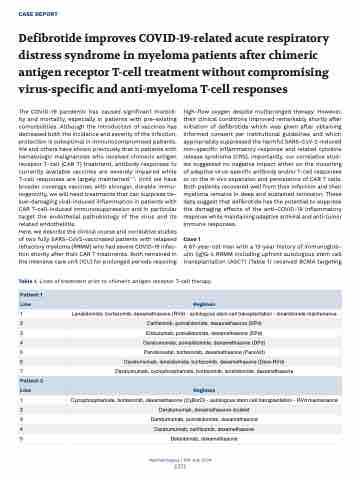
A 67-year-old man with a 13-year history of immunoglob- ulin (Ig)G-λ RRMM including upfront autologous stem cell transplantation (ASCT) (Table 1) received BCMA targeting
Table 1. Lines of treatment prior to chimeric antigen receptor T-cell therapy.
  Patient 1
 Line
 Regimen
 1
  Lenalidomide, bortezomib, dexamethasone (RVd) - autologous stem cell transplantation - lenalidomide maintenance
 2
Carfilzomib, pomalidomide, dexamethasone (KPd)
 3
  Elotuzumab, pomalidomide, dexamethasone (EPd)
 4
 Daratumumab, pomalidomide, dexamethasone (DPd)
 5
Panobinostat, bortezomib, dexamethasone (PanoVd)
 6
 Daratumumab, lenalidomide, bortezomib, dexamethasone (Dara-RVd)
 7
  Daratumumab, cyclophosphamide, bortezomib, lenalidomide, dexamethasone
 Patient 2
 Line
 Regimen
 1
  Cyclophosphamide, bortezomib, dexamethasone (CyBorD) - autologous stem cell transplantation - RVd maintenance
 2
Daratumumab, dexamethasone doublet
 3
 Daratumumab, pomalidomide, dexamethasone
 4
  Daratumumab, carfilzomib, dexamethasone
 5
 Belantamab, dexamethasone
  Haematologica | 109 July 2024
2372


