


Page 347 - Haematologica Vol. 109 - July 2024
P. 347
LETTER TO THE EDITOR
remaining three cases, the cause of death was general deterioration, second malignancy, and neurotoxicity after radiotherapy at relapse.
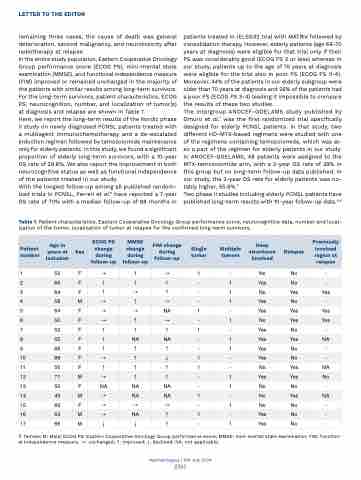
In the entire study population, Eastern Cooperative Oncology Group performance score (ECOG PS), mini-mental state examination (MMSE), and functional independence measure (FIM) improved or remained unchanged in the majority of the patients with similar results among long-term survivors. For the long-term survivors, patient characteristics, ECOG PS, neurocognition, number, and localization of tumor(s) at diagnosis and relapse are shown in Table 1.
Here, we report the long-term results of the Nordic phase II study on newly diagnosed PCNSL patients treated with a multiagent immunochemotherapy and a de-escalated induction regimen followed by temozolomide maintenance only for elderly patients. In this study, we found a significant proportion of elderly long-term survivors, with a 10-year OS rate of 29.8%. We also report the improvement in both neurocognitive status as well as functional independence of the patients treated in our study.
With the longest follow-up among all published random- ized trials in PCNSL, Ferreri et al.6 have reported a 7-year OS rate of 70% with a median follow-up of 88 months in
patients treated in IELSG32 trial with MATRix followed by consolidation therapy. However, elderly patients (age 66-70 years at diagnosis) were eligible for that trial only if their PS was considerably good (ECOG PS 2 or less) whereas in our study, patients up to the age of 75 years at diagnosis were eligible for the trial also in poor PS (ECOG PS 0-4). Moreover, 44% of the patients in our elderly subgroup were older than 70 years at diagnosis and 26% of the patients had a poor PS (ECOG PS 3-4) leading it impossible to compare the results of these two studies.
The intergroup ANOCEF-GOELAMS study published by Omuro et al.7 was the first randomized trial specifically designed for elderly PCNSL patients. In that study, two different HD-MTX-based regimens were studied with one of the regimens containing temozolomide, which was al- so a part of the regimen for elderly patients in our study. In ANOCEF-GOELAMS, 48 patients were assigned to the MTX-temozolomide arm, with a 2-year OS rate of 39% in this group but no long-term follow-up data published. In our study, the 2-year OS rate for elderly patients was no- tably higher, 55.6%.4
Two phase II studies including elderly PCNSL patients have published long-term results with 10-year follow-up data.8,9
Table 1. Patient characteristics, Eastern Cooperative Oncology Group performance score, neurocognitive data, number and local- ization of the tumor, localization of tumor at relapse for the confirmed long-term survivors.
 Patient number
 Age in years at inclusion
  Sex
  ECOG PS change during follow-up
 MMSE change during follow-up
 FIM change during follow-up
 Single tumor
 Multiple tumors
  Deep structures involved
 Relapse
 Previously involved region at relapse
 1
  52
 F
 →
  ↑
  →
  1
  -
  No
  No
  -
 2
66
F
↑
↑
↑
-
1
Yes
No
-
 3
 64
F
 ↑
 →
 ↑
 -
 1
 No
 Yes
 Yes
 4
 58
M
 →
 ↑
 →
 -
 1
 Yes
 No
 -
 5
  64
 F
 →
  →
  NA
  1
  -
  Yes
  Yes
  Yes
 6
 50
 F
→
 ↑
 →
 -
 1
 No
 Yes
 Yes
 7
52
F
↑
↑
↑
1
-
Yes
No
-
 8
 55
F
 ↑
 NA
 NA
 -
 1
 Yes
 Yes
 NA
 9
 66
F
 ↑
 ↑
 ↑
 -
 1
 Yes
 No
 -
 10
 68
F
 →
  ↑
 ↓
 1
 -
 Yes
 No
 -
  11
 50
F
↑
 ↑
 ↑
 1
 -
 No
 Yes
NA
 12
  71
 M
 →
  ↑
  ↑
  -
  1
  Yes
  Yes
  No
 13
50
F
NA
NA
NA
-
1
No
No
-
 14
 40
M
 →
 NA
 NA
 1
 -
 No
 Yes
 NA
 15
 69
F
 →
 →
 →
 -
 1
 No
 No
 -
 16
 63
M
 →
 NA
 ↑
 1
 -
 Yes
 No
 -
 17
  66
 M
 ↓
  ↓
  ↑
  -
  1
  Yes
  No
  -
   F: female; M: Male; ECOG PS: Eastern Cooperative Oncology Group performance score; MMSE: mini-mental state examination; FIM: function- al independence measure; →: unchanged; ↑: improved; ↓: declined; NA: not applicable.
Haematologica | 109 July 2024
2361


