


Page 337 - Haematologica Vol. 109 - July 2024
P. 337
LETTER TO THE EDITOR
High annualized bleeding rates in pediatric patients with inherited platelet function disorders
Platelet function disorders are common inherited bleeding disorders.1,2 While severe inherited platelet function disor- ders (IPFD) such as Glanzmann thrombasthenia and Bernard Soulier syndrome are easier to diagnose, diagnosing milder phenotypes of IPFD remains complex. Up to 9% of healthy children can have epistaxis, and 12% of infants in the general pediatric population demonstrate bruising, complicating the ability to diagnose IPFD in otherwise healthy children.3,4 Structured bleeding assessment tools (BAT), such as those developed by the International Society of Thrombosis and Hemostasis (ISTH), are useful as screening instruments to guide testing for bleeding disorders.5,6 Our group has pre- viously established an IPFD incidence of 4.5% in an unse- lected, prospective cohort of adolescents referred for heavy menstrual bleeding (HMB) using ISTH-BAT and systematic testing for IPFD.7 We aimed to determine the prevalence and types of IPFD in children referred for bleeding, examine bleeding events and annualized bleeding rates (ABR), and investigate the predictive ability of the ISTH-BAT for IPFD diagnosis, treatment for bleeding events, and severe bleed- ing events. We hypothesized that bleeding scores (BS) are higher in pediatric patients with IPFD than those without, and that the ISTH-BAT would predict bleeding events and receipt of treatment in IPFD.
Our retrospective study, approved by the institutional re- view board, included patients aged 0 to 18 years referred for bleeding symptoms between 2019 and 2021 to The Uni- versity of Texas Southwestern Medical Center (UTSW) Pedi- atric Hemostasis and Thrombosis Program. A standardized hemostatic evaluation is undertaken for every patient with high suspicion for primary hemostatic defect. The minimum standardized evaluation includes a complete blood count
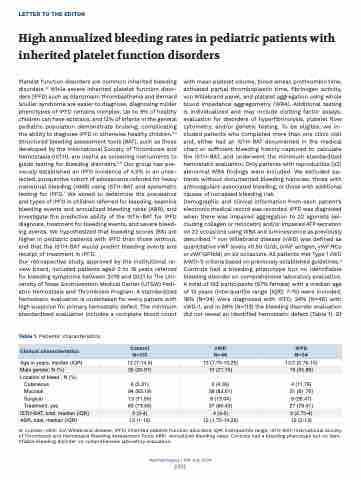
Table 1. Patients’ characteristics.
with mean platelet volume, blood smear, prothrombin time, activated partial thromboplastin time, fibrinogen activity, von Willebrand panel, and platelet aggregation using whole blood impedance aggregometry (WBA). Additional testing is individualized and may include clotting factor assays, evaluation for disorders of hyperfibrinolysis, platelet flow cytometry, and/or genetic testing. To be eligible, we in- cluded patients who completed more than one clinic visit and, either had an ISTH-BAT documented in the medical chart or sufficient bleeding history captured to calculate the ISTH-BAT, and underwent the minimum standardized hemostatic evaluation. Only patients with reproducible (≥2) abnormal WBA findings were included. We excluded pa- tients without documented bleeding histories, those with anticoagulant-associated bleeding, or those with additional causes of increased bleeding risk.
Demographic and clinical information from each patient’s electronic medical record was recorded. IPFD was diagnosed when there was impaired aggregation to ≥2 agonists (ex- cluding collagen or ristocetin) and/or impaired ATP secretion on ≥2 occasions using WBA and luminescence as previously described.7,8 von Willebrand disease (vWD) was defined as quantitative vWF levels <0.50 IU/dL (vWF antigen, vWF:RCo or vWF:GP1bM) on ≥2 occasions. All patients met Type 1 vWD (vWD-1) criteria based on previously established guidelines.9 Controls had a bleeding phenotype but no identifiable bleeding disorder on comprehensive laboratory evaluation. A total of 193 participants (67% female) with a median age of 13 years (interquartile range [IQR]: 7-15) were included; 18% (N=34) were diagnosed with IPFD, 24% (N=46) with vWD-1, and in 58% (N=113) the bleeding disorder evaluation did not reveal an identified hemostatic defect (Table 1). Of
 Clinical characteristics
 Control N=113
 vWD N=46
 IPFD N=34
Age in years, median (IQR)
 12 (7-14.5)
 13 (7.75-15.25)
 13.5 (5.75-15)
 Male gender, N (%)
 35 (30.97)
 10 (21.74)
 19 (55.88)
 Location of bleed , N (%)
    Cutaneous
6 (5.31)
2 (4.35)
4 (11.76)
Mucosal
94 (83.19)
38 (82.61)
21 (61.76)
Surgical
13 (11.50)
6 (13.04)
9 (26.47)
Treatment, yes
 83 (73.45)
 37 (80.43)
 27 (79.41)
 ISTH-BAT, total, median (IQR)
3 (3-4)
4 (3-5)
3 (2.75-4)
ABR, total, median (IQR)
  12 (1-13)
  12 (1.75-14.25)
  12 (2-13)
    N: number; vWD: von Willebrand disease; IPFD: inherited platelet function disorders; IQR: interquartile range; ISTH-BAT: International Society of Thrombosis and Hemostasis Bleeding Assessment Tools; ABR: annualized bleeding rates. Controls had a bleeding phenotype but no iden- tifiable bleeding disorder on comprehensive laboratory evaluation.
Haematologica | 109 July 2024
2351


