


Page 290 - Haematologica Vol. 109 - July 2024
P. 290
LETTER TO THE EDITOR
with timing of vaccination in our previous patient studies.13 Two Triplex vaccine dose levels (DL1=108 PFU and DL2=5x 10⁸ PFU) were evaluated in two age groups (11-21 and 1-10 years old). DL2 is the Triplex dose administered to healthy adults and HCT patients in our published trials.13 Triplex-related adverse event (AE) assessment, including GVHD, non-re- lapse mortality, relapse, CMV reactivation requiring PET and CMV disease were prospectively monitored, recorded according to institutional standard of care, and summarized in Table 1 and Online Supplementary Table 1S. The impact of Triplex on cellular immunity was investigated and focused on magnitude, function, and quality of CMV-specific CD4 and CD8 T-cell expansion. Longitudinal immune monitoring was performed measuring 4-1BB (CD137) surrogate marker of T-cell activation by surface staining of peripheral blood mononuclear cells (PBMC), following 24 hours of stimulation with either pp65, IE1 or IE2 peptide libraries and medium as control. The CD137 assay was combined with the mon- itoring of CD28, CD45RA memory phenotype markers,14 to achieve a comprehensive immunological assessment of the Triplex vaccine effect on quantity and quality of CMV-spe- cific T-cell functional expansion. PBMC from blood draws obtained before Triplex vaccination at day 28 and afterwards on days 42, 56, 70, 84, 100, 140, 180, and 270 were analyzed by fluorescence-activated cytometry in the research lab- oratory setting (FC; GalliosTM, Beckman Coulter with Kalu- za analysis software, Brea, CA).2 Concentrations of pp65, IE1- or IE2-specific CD3+CD4+CD137+ and CD3+CD8+CD137+ T cells were longitudinally measured using multiparameter (6 colors) flowcytometry. When either CMV-specific CD3+C- D8+CD137+ T-cell or CD3+CD4+CD137+ T-cell populations were ≥0.2%, a further analysis for CD28 and CD45RA memory membrane markers could be performed. CD45RA+CD28+ cells were classified as naïve; CD45RA- CD28+ cells, as central memory (TCM); and CD28- cells, as effector T cells. Within the effector T-cell group, two subpopulations were identified: CD45RA-CD28- cells (TEM) and CD45RA+CD28- effector “revertant” T cells, re-expressing the RA isoform of the CD45 surface marker (TEMRA).
From August 2018 to April 2023, nine eligible patients each received two injections of Triplex with no safety concerns and no dose limiting toxicity. Triplex was well tolerated at both DL and no AE grade ≥2 possibly or probable related to the vaccine was recorded (Table 1). Enrollment for DL1 vaccinees included three transplant 11-21-year-old recipi- ents and three 1-10-year-old recipients. In the DL2, three transplant 11-21-year-old recipients were vaccinated. All nine participants completed the two injection Triplex vaccination regimen. All except one patient (COH002) received leter- movir prophylaxis. CMV reactivation was treated with PET on day 44 for COH002 and on day 216 for COH011 following >1.0 mg/kg steroid treatment for chronic GVHD. COH014 withdrew from study on day 140 post-HCT, to return to their home country; no history of CMV reactivation was observed through 1-year post-HCT. COH013 experienced
relapse on day 158 post-HCT and further research blood draws were suspended.
We found high levels of functional CMV-specific T cells fol-
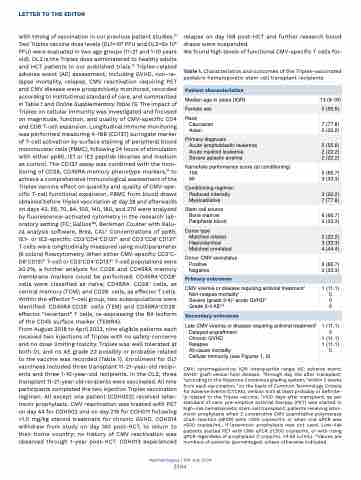
Table 1. Characteristics and outcomes of the Triplex-vaccinated pediatric hematopoietic stem cell transplant recipients.
 Patient characteristics
 Median age in years (IQR)
 13 (8-18)
 Female sex
  5 (55.6)
 Race Caucasian Asian
 7 (77.8) 2 (22.2)
  Primary diagnosis
Acute lymphoblastic leukemia Acute myeloid leukemia Severe aplastic anemia
  5 (55.6) 2 (22.2) 2 (22.2)
 Karnofsky performance score (at conditioning) 100
90
 6 (66.7) 3 (33.3)
 Conditioning regimen Reduced intensity Myeloablative
  2 (22.2) 7 (77.8)
 Stem cell source Bone marrow Peripheral blood
 6 (66.7) 3 (33.3)
  Donor type
Matched related Haploidentical Matched unrelated
  2 (22.2) 3 (33.3) 4 (44.4)
 Donor CMV serostatus Positive
Negative
 6 (66.7) 3 (33.3)
  Primary outcomes
  CMV viremia or disease requiring antiviral treatment1 Non-relapse mortality1
Severe (grade 3-4)2 acute GVHD3
Grade 3-4 AE3,4
   1 (11.1) 0
  Secondary outcomes
  Late CMV viremia or disease requiring antiviral treatment5 Delayed engraftment
Chronic GVHD
Relapse
All-cause mortality
Cellular immunity (see Figures 1, 2)
    1 (11.1) 0
1 (11.1) 1 (11.1) 0
  Haematologica | 109 July 2024
2304
CMV: cytomegalovirus; IQR: interquartile range; AE: adverse event; GVHD: graft-versus-host disease. 1Through day 100 after transplant; 2according to the Keystone Consensus grading system; 3within 2 weeks from each vaccination; 4on the basis of Common Terminology Criteria for Adverse Events (CTCAE), version 4.03 at least probably or definite- ly related to the Triplex vaccine; 5>100 days after transplant; as per standard of care, pre-emptive antiviral therapy (PET) was started in high-risk hematopoietic stem cell transplant; patients receiving leter- movir prophylaxis when 2 consecutive CMV quantitative polymerase chain reaction (qPCR) were >500 copies/mL or when one qPCR was >500 copies/mL, if letermovir prophylaxis was not used. Low-risk patients started PET with CMV qPCR ≥1,500 copies/mL or with rising qPCR regardless of prophylaxis (1 copy/mL ≈0.93 IU/mL). *Values are numbers of patients (percentages) unless otherwise indicated.


