


Page 221 - Haematologica Vol. 109 - July 2024
P. 221
ARTICLE - Carfilzomib, thalidomide and dexamethasone (KTd) in RRMM S. Ninkovic et al.
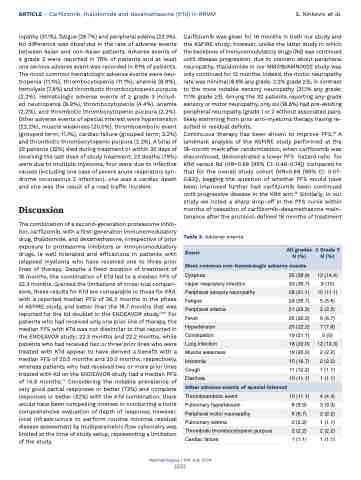
ropathy (31.1%), fatigue (26.7%) and peripheral edema (23.3%). No difference was observed in the rate of adverse events between Asian and non-Asian patients. Adverse events of ≥ grade 3 were reported in 76% of patients and at least one serious adverse event was recorded in 61% of patients. The most common hematologic adverse events were neu- tropenia (11.1%), thrombocytopenia (11.1%), anemia (8.9%), hemolysis (7.8%) and thrombotic thrombocytopenic purpura (2.2%). Hematologic adverse events of ≥ grade 3 includ- ed neutropenia (8.9%), thrombocytopenia (4.4%), anemia (2.2%), and thrombotic thrombocytopenic purpura (2.2%). Other adverse events of special interest were hypertension (22.2%), muscle weakness (20.0%), thromboembolic event (grouped term; 11.1%), cardiac failure (grouped term; 2.2%) and thrombotic thrombocytopenic purpura (2.2%). A total of 29 patients (32%) died during treatment or within 30 days of receiving the last dose of study treatment; 23 deaths (79%) were due to multiple myeloma, four were due to infective causes (including one case of severe acute respiratory syn- drome coronavirus 2 infection), one was a cardiac death and one was the result of a road traffic incident.
Discussion
The combination of a second-generation proteasome inhib- itor, carfilzomib, with a first-generation immunomodulatory drug, thalidomide, and dexamethasone, irrespective of prior exposure to proteasome inhibitors or immunomodulatory drugs, is well tolerated and efficacious in patients with relapsed myeloma who have received one to three prior lines of therapy. Despite a fixed duration of treatment of 18 months, the combination of KTd led to a median PFS of 22.3 months. Granted the limitations of cross-trial compari- sons, these results for KTd are comparable to those for KRd, with a reported median PFS of 26.3 months in the phase III ASPIRE study, and better than the 18.7 months that was reported for the Kd doublet in the ENDEAVOR study.10,14 For patients who had received only one prior line of therapy, the median PFS with KTd was not dissimilar to that reported in the ENDEAVOR study; 22.3 months and 22.2 months, while patients who had received two or three prior lines who were treated with KTd appear to have derived a benefit with a median PFS of 20.5 months and 20.0 months, respectively, whereas patients who had received two or more prior lines treated with Kd on the ENDEAVOR study had a median PFS of 14.9 months.17 Considering the notable prevalence of very good partial responses or better (73%) and complete responses or better (32%) with the KTd combination, there would have been compelling interest in conducting a more comprehensive evaluation of depth of response; however, local infrastructure to perform routine minimal residual disease assessment by multiparametric flow cytometry was limited at the time of study setup, representing a limitation of the study.
Carfilzomib was given for 18 months in both our study and the ASPIRE study; however, unlike the latter study in which the backbone of immunomodulatory drugs (Rd) was continued until disease progression, due to concern about peripheral neuropathy, thalidomide in our MM018/AMN0002 study was only continued for 12 months. Indeed, the motor neuropathy rate was minimal (6.6% any grade, 2.2% grade ≥3), in contrast to the more notable sensory neuropathy (31.1% any grade; 11.1% grade ≥3). Among the 32 patients reporting any-grade sensory or motor neuropathy, only six (18.8%) had pre-existing peripheral neuropathy (grade 1 or 2 without associated pain), likely stemming from prior anti-myeloma therapy having re- sulted in residual deficits.
Continuous therapy has been shown to improve PFS.18 A landmark analysis of the ASPIRE study performed at the 18-month mark after randomization, when carfilzomib was discontinued, demonstrated a lower PFS hazard ratio for KRd versus Rd (HR=0.58 [95% CI: 0.46-0.74]) compared to that for the overall study cohort (HR=0.69 [95% CI: 0.57- 0.83]), begging the question of whether PFS would have been improved further had carfilzomib been continued until progressive disease in the KRd arm.19 Similarly, in our study we noted a sharp drop-off in the PFS curve within months of cessation of carfilzomib-dexamethasone main- tenance after the protocol-defined 18 months of treatment
Table 3. Adverse events.
 Event
 All grades N (%)
  ≥ Grade 3 N (%)
  Most common non-hematologic adverse events
 Dyspnea
 35 (38.9)
 13 (14.4)
 Upper respiratory infection
 33 (36.7)
 9 (10)
 Peripheral sensory neuropathy
 28 (31.1)
 10 (11.1)
 Fatigue
 24 (26.7)
 5 (5.6)
 Peripheral edema
 21 (23.3)
 2 (2.2)
 Fever
 20 (22.2)
 6 (6.7)
 Hypertension
  20 (22.2)
  7 (7.8)
 Constipation
19 (21.1)
0 (0)
 Lung infection
  18 (20.0)
  12 (13.3)
 Muscle weakness
18 (20.0)
2 (2.2)
 Insomnia
  15 (16.7)
  2 (2.2)
 Cough
11 (12.2)
1 (1.1)
 Diarrhea
  10 (11.1)
  1 (1.1)
 Other adverse events of special interest
 Thromboembolic event
 10 (11.1)
 4 (4.4)
 Pulmonary hypertension
 8 (8.9)
 3 (3.3)
 Peripheral motor neuropathy
 6 (6.7)
 2 (2.2)
 Pulmonary edema
 2 (2.2)
 1 (1.1)
 Thrombotic thrombocytopenic purpura
 2 (2.2)
 2 (2.2)
 Cardiac failure
  1 (1.1)
  1 (1.1)
  Haematologica | 109 July 2024
2235


