


Page 184 - Haematologica Vol. 109 - July 2024
P. 184
ARTICLE - Disease burden of idiopathic MCD
feeling weak, sores or rash on skin (skin lesions), itching, numbness or tingling, pain, fever, swollen lymph nodes, swelling or edema in other body areas, night sweats, and excessive daytime sweating.
Statistical analyses
M. Sarmiento Bustamante et al. The ACCELERATE natural history registry has received ethical
approval from the University of Pennsylvania Institutional Review Board, with the most recent approval being given on March 9, 2023 (protocol: 824758).
Results
Patients with idiopathic multicentric Castleman disease present with severe clinical and laboratory abnormalities
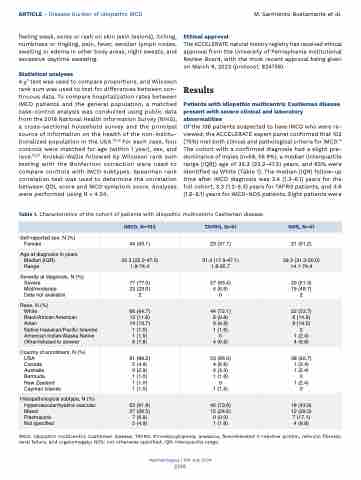
Of the 136 patients suspected to have iMCD who were re- viewed, the ACCELERATE expert panel confirmed that 102 (75%) met both clinical and pathological criteria for iMCD.10 The cohort with a confirmed diagnosis had a slight pre- dominance of males (n=58, 56.9%), a median (interquartile range [IQR]) age of 35.3 (22.2-47.5) years, and 65% were identified as White (Table 1). The median (IQR) follow-up time after iMCD diagnosis was 3.4 (1.3-6.1) years for the full cohort, 3.3 (1.2-5.3) years for TAFRO patients, and 3.6 (1.6-8.1) years for iMCD-NOS patients. Eight patients were
A χ2 test was used to compare proportions, and Wilcoxon rank sum was used to test for differences between con- tinuous data. To compare hospitalization rates between iMCD patients and the general population, a matched case-control analysis was conducted using public data from the 2018 National Health Information Survey (NHIS), a cross-sectional household survey and the principal source of information on the health of the non-institu- tionalized population in the USA.19,20 For each case, four controls were matched for age (within 1 year), sex, and race.19,20 Kruskal-Wallis followed by Wilcoxon rank sum testing with the Bonferroni correction were used to compare controls with iMCD subtypes. Spearman rank correlation test was used to determine the correlation between QOL score and MCD symptom score. Analyses were performed using R v 4.04.
Table 1. Characteristics of the cohort of patients with idiopathic multicentric Castleman disease.
Ethical approval
   iMCD, N=102
  TAFRO, N=61
  NOS, N=41
 Self-reported sex, N (%) Female
 44 (43.1)
 23 (37.7)
 21 (51.2)
 Age at diagnosis in years Median (IQR)
Range
 35.3 (22.2-47.5) 1.8-74.4
 31.4 (17.9-47.1) 1.8-65.7
 39.3 (31.3-50.0) 14.1-74.4
   Severity at diagnosis, N (%) Severe
Mild/moderate
Data not available
  77 (77.0) 23 (23.0) 2
  57 (93.4) 4 (6.6) 0
  20 (51.3) 19 (48.7) 2
   Race, N (%) White
Black/African American
Asian
Native Hawaiian/Pacific Islander American Indian/Alaska Native Other/refused to answer
 66 (64.7) 12 (11.8) 14 (13.7) 1 (1.0)
1 (1.0) 8 (7.8)
 44 (72.1) 6 (9.8) 6 (9.8) 1 (1.6) 0
4 (6.6)
 22 (53.7) 6 (14.6) 8 (19.5) 0
1 (2.4) 4 (9.8)
 Country of enrollment, N (%) USA
Canada Australia Bermuda
New Zealand Cayman Islands
  91 (89.2) 5 (4.9) 3 (2.9) 1 (1.0) 1 (1.0) 1 (1.0)
  53 (86.9) 4 (6.6) 2 (3.3) 1 (1.6) 0
1 (1.6)
  38 (92.7) 1 (2.4) 1 (2.4) 0
1 (2.4) 0
 Histopathological subtype, N (%) Hypervascular/hyaline vascular Mixed
Plasmacytic
Not specified
   63 (61.8) 27 (26.5) 7 (6.9) 5 (4.9)
   45 (73.8) 15 (24.6) 0 (0.0) 1 (1.6)
   18 (43.9) 12 (29.3) 7 (17.1) 4 (9.8)
   iMCD: idiopathic multicentric Castleman disease; TAFRO: thrombocytopenia, anasarca, fever/elevated C-reactive protein, reticulin fibrosis/ renal failure, and organomegaly; NOS: not otherwise specified; IQR: interquartile range.
Haematologica | 109 July 2024
2198


