


Page 166 - Haematologica Vol. 109 - July 2024
P. 166
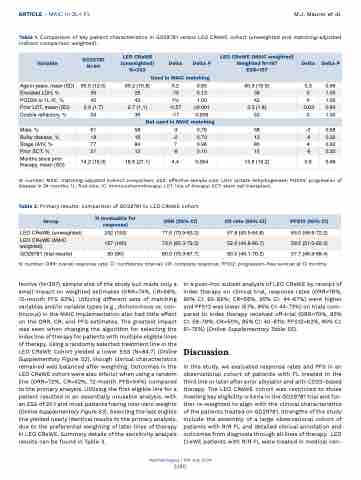
ARTICLE - MAIC in 3L+ FL M.J. Maurer et al. Table 1. Comparison of key patient characteristics in GO29781 versus LEO CReWE cohort (unweighted and matching-adjusted
indirect comparison weighted).
 Variable
  GO29781 N=90
  LEO CReWE (unweighted) N=202
  Delta
  Delta P
  LEO CReWE (MAIC weighted) Weighted N=167 ESS=127
  Delta
  Delta P
 Used in MAIC matching
Age in years, mean (SD)
 60.0 (12.0)
 60.2 (10.8)
 0.2
 0.85
 60.3 (10.5)
 0.3
 0.69
 Elevated LDH, %
 39
 29
 -10
 0.13
 39
 0
 1.00
 POD24 to 1L IC, %
 42
 43
 1%
 1.00
 42
 0
 1.00
 Prior LOT, mean (SD)
  3.3 (1.7)
  2.7 (1.1)
  -0.57
  <0.001
  3.3 (1.8)
  -0.03
  0.83
  Double refractory, %
 53
 36
 -17
 0.009
 53
 0
 1.00
 Not used in MAIC matching
Male, %
  61
  58
  -3
  0.76
  58
  -3
  0.68
  Bulky disease, %
18
16
-2
0.73
12
-6
0.32
Stage III/IV, %
 77
 84
 7
 0.96
 80
 4
 0.62
 Prior SCT, %
  21
  13
  -8
  0.10
  15
  -6
  0.32
  Months since prior therapy, mean (SD)
 14.2 (16.9)
 18.6 (21.1)
 4.4
 0.004
 14.8 (19.2)
 0.6
 0.68
   N: number; MAIC: matching-adjusted indirect comparison; ESS: effective sample size; LDH: lactate dehydrogenase; POD24: progression of disease in 24 months; 1L: first-line; IC: immunochemotherapy; LOT: line of therapy; SCT: stem cell transplant.
Table 2. Primary results: comparison of GO29781 to LEO CReWE cohort.
N: number; ORR: overall response rate; CI: confidence interval; CR: complete response; PFS12: progression-free survival at 12 months.
 Group
 N (evaluable for response)
 ORR (95% CI)
 CR rate (95% CI)
 PFS12 (95% CI)
LEO CReWE (unweighted)
  202 (192)
  77.6 (70.9-83.2)
  57.8 (50.5-64.8)
  65.0 (58.6-72.2)
  LEO CReWE (MAIC weighted)
167 (160)
73.0 (65.3-79.5)
52.9 (44.8-60.7)
59.5 (51.0-69.3)
GO29781 (trial results)
  90 (90)
  80.0 (70.3-87.7)
  60.0 (49.1-70.2)
  57.7 (46.9-68.4)
    fective (N=297) sample size of the study but made only a small impact on weighted estimates (ORR=74%, CR=56%, 12-month PFS 63%). Utilizing different sets of matching variables and/or variable types (e.g., dichotomous vs. con- tinuous) in the MAIC implementation also had little effect on the ORR, CR, and PFS estimates. The greatest impact was seen when changing the algorithm for selecting the index line of therapy for patients with multiple eligible lines of therapy. Using a randomly selected treatment line in the LEO CReWE Cohort yielded a lower ESS (N=84.7) (Online Supplementary Figure S2), though clinical characteristics remained well balanced after weighting. Outcomes in the LEO CReWE cohort were also inferior when using a random line (ORR=72%, CR=42%, 12-month PFS=54%) compared to the primary analysis. Utilizing the first eligible line for a patient resulted in an essentially unusable analysis, with an ESS of 20.1 and most patients having near-zero weights (Online Supplementary Figure S3). Selecting the last eligible line yielded nearly identical results to the primary analysis, due to the preferential weighting of later lines of therapy in LEO CReWE. Summary details of the sensitivity analysis results can be found in Table 3.
In a post-hoc subset analysis of LEO CReWE by receipt of index therapy on clinical trial, response rates (ORR=76%, 95% CI: 65-85%; CR=56%, 95% CI: 44-67%) were higher and PFS12 was lower (57%, 95% CI: 44-73%) on trials com- pared to index therapy received off-trial (ORR=70%, 95% CI: 59-79%; CR=50%, 95% CI: 40-61%; PFS12=62%, 95% CI: 51-75%) (Online Supplementary Table S5).
Discussion
In this study, we evaluated response rates and PFS in an observational cohort of patients with FL treated in the third line or later after prior alkylator and anti-CD20-based therapy. The LEO CReWE cohort was restricted to those meeting key eligibility criteria in the GO29781 trial and fur- ther re-weighted to align with the clinical characteristics of the patients treated on GO29781. Strengths of the study include the assembly of a large observational cohort of patients with R/R FL and detailed clinical annotation and outcomes from diagnosis through all lines of therapy. LEO CreWE patients with R/R FL were treated in medical cen-
Haematologica | 109 July 2024
2180


