


Page 113 - Haematologica Vol. 109 - July 2024
P. 113
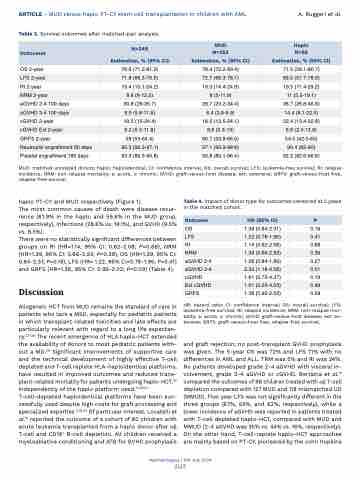
ARTICLE - MUD versus haplo PT-CY stem cell transplantation in children with AML A. Ruggeri et al. Table 3. Survival outcomes after matched-pair analysis.
 Outcomes
 N=348
 MUD N=253
 Haplo N=95
 Estimation, % (95% CI)
 Estimation, % (95% CI)
 Estimation, % (95% CI)
 OS 2-year
  76.6 (71.2-81.2)
  78.4 (72.2-83.4)
  71.5 (59.1-80.7)
 LFS 2-year
71.8 (66.3-76.6)
72.7 (66.3-78.1)
69.5 (57.7-78.6)
 RI 2-year
 19.4 (15.1-24.2)
 19.3 (14.4-24.9)
 19.5 (11.4-29.2)
 NRM 2-year
  8.8 (6-12.2)
  8 (5-11.9)
  11 (5.2-19.1)
 aGVHD 2-4 100 days
30.8 (26-35.7)
28.7 (23.2-34.4)
36.7 (26.8-46.6)
 aGVHD 3-4 100 days
 8.5 (5.8-11.8)
 6.4 (3.8-9.9)
 14.4 (8.1-22.5)
 cGVHD 2-year
 19.5 (15-24.4)
 18.5 (13.5-24.1)
 22.4 (13.4-32.8)
 cGVHD Ext 2-year
  8.2 (5.3-11.8)
  8.6 (5.3-13)
  6.6 (2.4-13.8)
 GRFS 2-year
59 (53-64.4)
60.7 (53.8-66.9)
54.5 (42.5-65)
 Neutrophil engraftment 60 days
  95.3 (92.3-97.1)
  97.1 (93.9-98.6)
  90.4 (82-95)
 Platelet engraftment 180 days
 93.3 (89.5-95.8)
 93.8 (89.1-96.4)
 92.2 (82.6-96.6)
   MUD: matched unrelated donors; haplo: haploidentical; CI: confidence interval; OS: overall survival; LFS: leukemia-free survival; RI: relapse incidence; NRM: non-relapse mortality; a: acute, c: chronic; GVHD: graft-versus-host disease; ext: extensive; GRFS: graft-versus-host free, relapse-free survival.
haplo PT-CY and MUD respectively (Figure 1).
The most common causes of death were disease recur- rence (61.9% in the haplo and 59.6% in the MUD group, respectively), infections (28.6% vs. 19.1%), and GVHD (9.5% vs. 8.5%).
There were no statistically significant differences between groups on RI (HR=1.14, 95% CI: 0.62-2.08; P=0.68), NRM (HR=1.39, 95% CI: 0.66-2.93; P=0.39), OS (HR=1.39, 95% CI: 0.84-2.31; P=0.19), LFS (HR= 1.22, 95% CI=0.76-1.95; P=0.41) and GRFS (HR=1.38, 95% CI: 0.95-2.02; P=0.09) (Table 4).
Discussion
Allogeneic HCT from MUD remains the standard of care in patients who lack a MSD, especially for pediatric patients in which transplant-related toxicities and late effects are particularly relevant with regard to a long life expectan- cy.23-28 The recent emergence of HLA haplo-HCT extended the availability of donors to most pediatric patients with- out a MD.29 Significant improvements of supportive care and the technical development of highly effective T-cell depleted and T-cell replete HLA-haploidentical platforms, have resulted in improved outcomes and reduced trans- plant-related mortality for patients undergoing haplo-HCT,30 independently of the haplo platform used.31,36,37 T-cell-depleted haploidentical platforms have been suc- cessfully used despite high costs for graft processing and specialized expertise.11,32,33 Of particular interest, Locatelli et al.10 reported the outcome of a cohort of 80 children with acute leukemia transplanted from a haplo donor after αb T-cell and CD19+ B-cell depletion. All children received a myeloablative conditioning and ATG for GVHD prophylaxis
Table 4. Impact of donor type for outcomes censored at 2 years in the matched cohort.
 Outcome
 HR (95% CI)
 P
OS
  1.39 (0.84-2.31)
  0.19
  LFS
1.22 (0.76-1.95)
0.41
RI
 1.14 (0.62-2.08)
 0.68
 NRM
  1.39 (0.66-2.93)
  0.39
  aGVHD 2-4
1.26 (0.84-1.89)
0.27
aGVHD 3-4
 2.33 (1.18-4.58)
 0.01
 cGVHD
  1.81 (0.75-4.37)
  0.19
  Ext cGVHD
 1.01 (0.25-4.03)
 0.99
 GRFS
 1.38 (0.95-2.02)
 0.09
   Haematologica | 109 July 2024
2127
HR: hazard ratio; CI: confidence interval; OS: overall survival; LFS: leukemia-free survival; RI: relapse incidence; NRM: non-relapse mor- tality; a: acute, c: chronic; GVHD: graft-versus-host disease; ext: ex- tensive; GRFS: graft-versus-host free, relapse-free survival.
and graft rejection; no post-transplant GVHD prophylaxis was given. The 5-year OS was 72% and LFS 71% with no differences in AML and ALL. TRM was 5% and RI was 24%. No patients developed grade 2-4 aGVHD with visceral in- volvement, grade 3-4 aGVHD or cGVHD. Bertaina et al.12 compared the outcomes of 98 children treated with αb T-cell depletion compared with 127 MUD and 118 mismatched UD (MMUD). Five-year LFS was not significantly different in the three groups (67%, 55%, and 62%, respectively), while a lower incidence of aGVHD was reported in patients treated with T-cell depleted haplo-HCT, compared with MUD and MMUD (2-4 aGVHD was 35% vs. 44% vs. 16%, respectively). On the other hand, T-cell-replete haplo-HCT approaches are mainly based on PT-CY, pioneered by the John Hopkins


